
OUR PROCESS
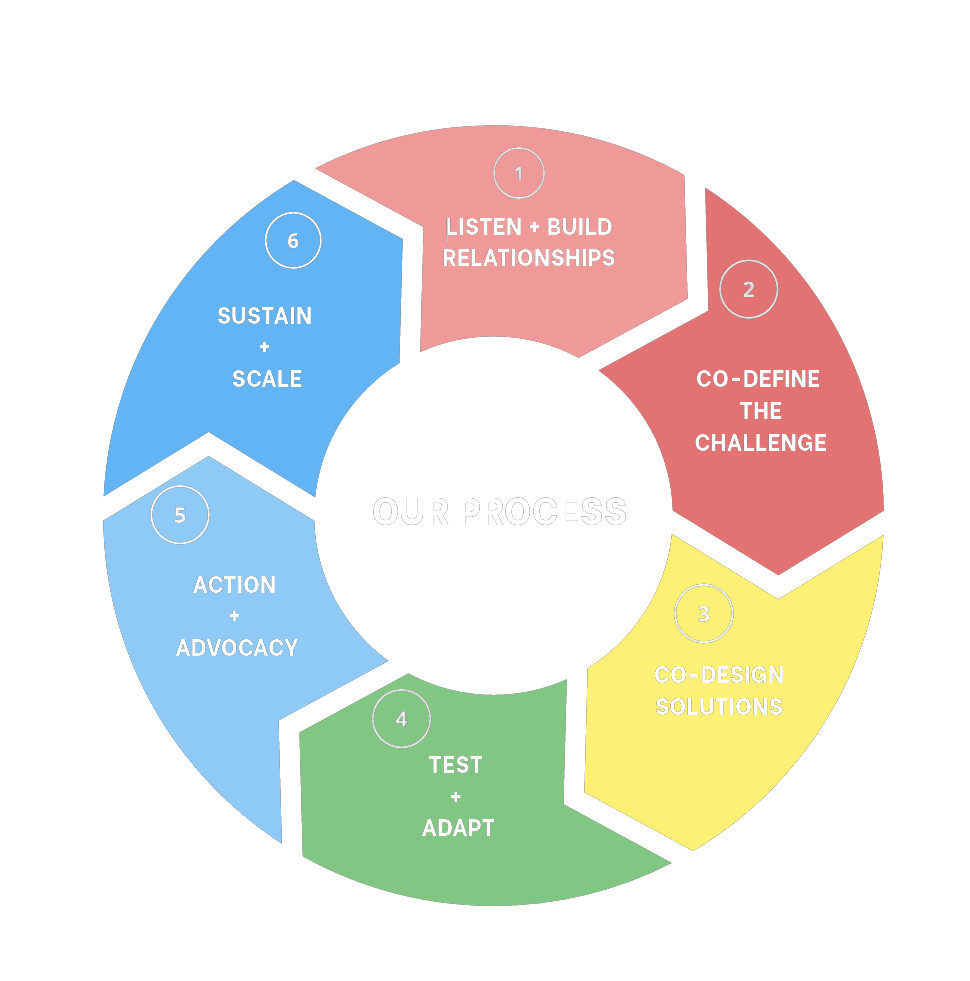
The UDesign Justice Initiative follows a cyclical, relationship-centred, and iterative process grounded in equity, care, and community leadership. Our approach recognizes that meaningful change in the built environment does not happen in a straight line. It requires continuous feedback loops, slow and intentional trust-building, and the flexibility to adapt as community priorities, contexts, and challenges evolve.
Our process blends qualitative storytelling, systems thinking, and practical design methods to move from insight to action, accountability, and long-term transformation.
At every stage, we move at the speed of relationships—ensuring that lived and living experience guides decisions, and that communities remain co-authors, not observers. This approach centres community leadership, values relational knowledge, and ensures that outcomes are shaped by those most directly impacted.
through collective design, community-led creativity, and architectural inclusivity. Our process is not a one-time sequence; it loops, adapts, and deepens over time. Each phase informs the next, and lessons learned are carried forward to strengthen future work.
“Design justice rethinks design processes, centers people who are normally marginalized by design, and uses collaborative, creative practices to address the deepest challenges our communities face.”
— Sasha Costanza-Chock, Design Justice, MIT Press, 2020
OUR PROCESS
LISTEN AND BUILD RELATIONSHIPS
We begin by engaging with communities most impacted by spatial inequities...
CO DEFINE THE CHALLENGE
Together with cross-sector collaborators we clarify what needs to change...

CO DESIGN SOLUTIONS
We translate community knowledge into prototypes, tools, and strategies...

TEST AND ADAPT
Prototypes are piloted and refined through community and partner feedback, ensuring the solutions are practical, culturally appropriate, equitable, and grounded in lived reality.
MOVE INTO ACTION AND ADVOCACY
Prototypes are piloted and refined through community and partner feedback, ensuring the solutions are practical, culturally appropriate, equitable, and grounded in lived reality.
SUSTAIN AND SCALE
We support long-term transformation by sharing learnings, building institutional memory, and strengthening the networks needed to sustain community-led change.